
Non-Traded REITs: Reported Values (as seen on a Statement)vs. Real Market Prices (what an investor's investment Will Sell For).
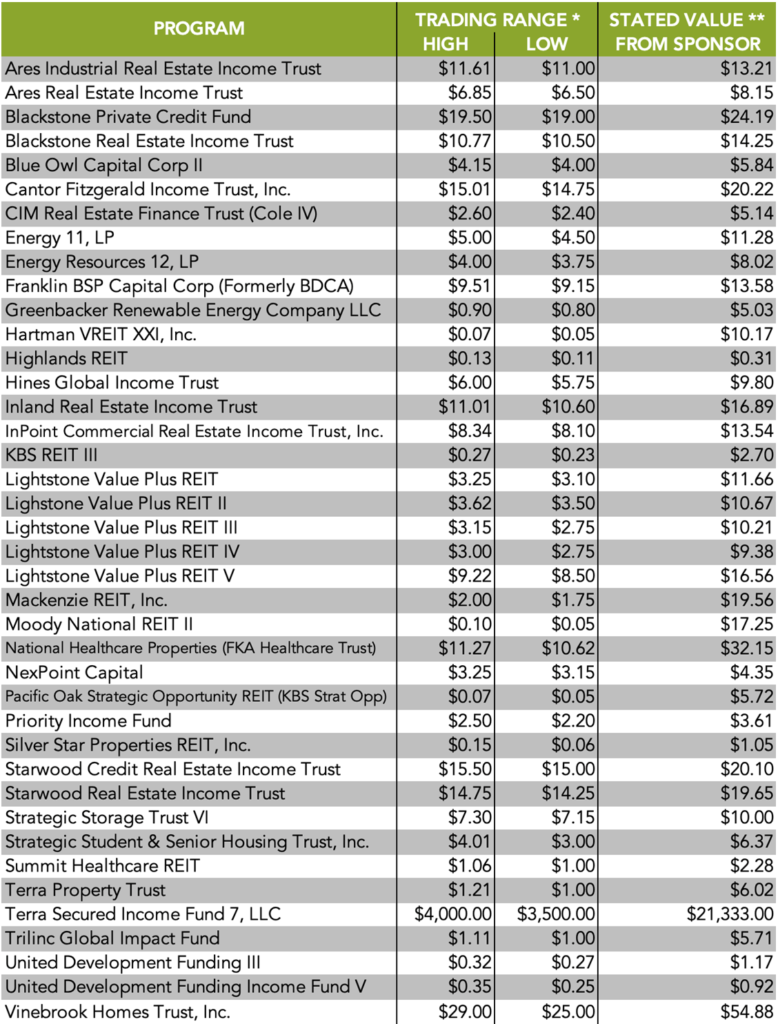
For years, many investors in non-traded REITs and private real estate investments believed their accounts were stable because the “stated value” on account statements appeared steady.
But when investors attempt to sell these products on the secondary market, they often discover a very different reality.
Secondary market trading prices for many non-traded REITs have traded at substantial discounts to the values reported by sponsors. In some cases, investments with reported values near $10 per share have traded for only a fraction of that amount.
This discrepancy can become critically important for retirees and conservative investors who were told these products were appropriate for income, safety, or preservation of principal.
“stated value” reported by the sponsor often bears little resemblance to what the investment actually trades for in the secondary market. The chart represents actual offering prices courtesy of Central Trade and Transfer who provide a very limited secondary market for those investors that need to sell their REIT shares.
It is true that a picture is worth a thousand words, this picture shows red flags for:
unsuitable investment claims,
damages discussions,
failure-to-supervise cases,
and elder investor exploitation narratives.
Some examples:
Lightstone products with sponsor values near $10–$16 trading near $3
KBS REIT III trading around pennies versus stated values many multiples higher
Hartman VREIT XXI showing near-wipeout pricing
VineBrook Homes showing large discounts between sponsor value and trading range
energy LPs trading far below sponsor valuations
This is exactly the kind of content investors search after discovering they cannot liquidate an investment near the value shown on account statements.
That distinction is important legally and psychologically.
One may say:
“My statements showed I still had $300,000.”
But when liquidation is attempted:
the actual market may only support $90,000–$150,000.
That disconnect is often the emotional turning point that causes investors to contact counsel.
“Why Non-Traded REIT Account Statements May Be Misleading”
“The Difference Between Sponsor Value and Actual Market Value”
“Non-Traded REIT Secondary Market Prices vs. Statement Values”
“Illiquid REITs: What Investors Discover When They Try to Sell”
from Mazer Law Firm PC https://mazerlawfirmpc.com/non-traded-reits-reported-statement-values-vs-real-market-prices-which-indicates-what-you-can-sell-it-for-and-cash-out/


